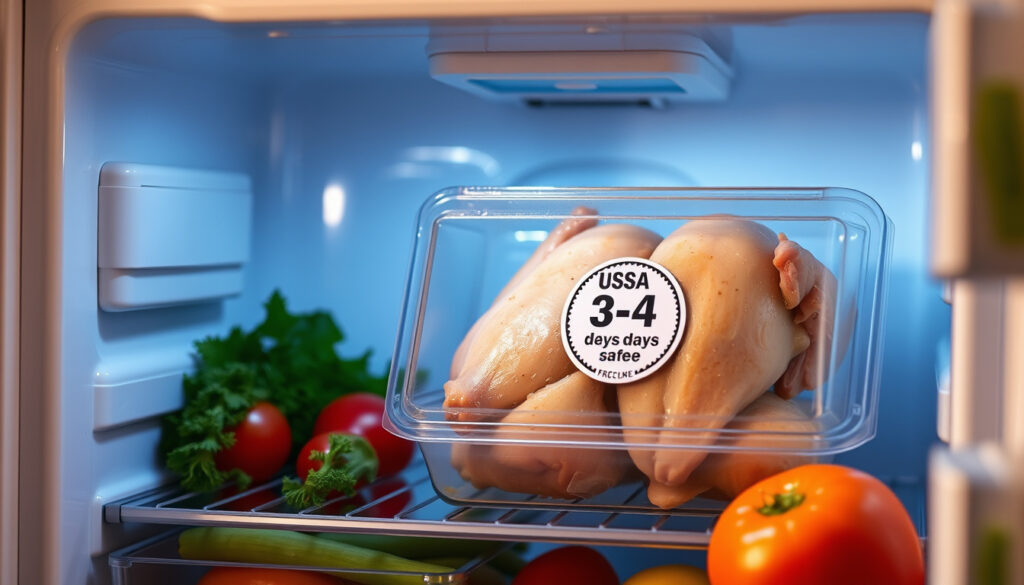
How Long Is Cooked Chicken Good For in the Fridge – 3-4 Days Per USDA
Knowing how long cooked chicken remains safe in the refrigerator is essential for preventing foodborne illness. According to federal food safety guidelines, properly stored cooked chicken can be safely consumed within a specific timeframe that balances quality and microbial safety.
This guide provides evidence-based recommendations from USDA, FDA, and other authoritative sources to help home cooks make informed decisions about storing and consuming leftover poultry. Understanding these timelines helps reduce the estimated 48 million cases of foodborne illness reported annually in the United States.
How Long Does Cooked Chicken Last in the Fridge?
The consensus among food safety authorities is clear: cooked chicken remains safe for consumption for 3–4 days when stored at or below 40°F (4.4°C). This guideline applies uniformly to all cooked poultry products, including rotisserie chicken, chicken breasts, thighs, and any other preparation method.
The USDA Food Code §3-501.14 establishes specific cooling requirements that food service establishments must follow. These regulations specify that cooked chicken must cool from 135°F to 70°F within 2 hours, then from 70°F to 41°F within an additional 4 hours. While these standards apply to commercial settings, they provide useful benchmarks for home cooks.
Your refrigerator must maintain a temperature at or below 40°F (4.4°C) to ensure food safety during storage. The freezer should stay at 0°F (-17.7°C) or below.
Storage Overview
Key Insights for Safe Storage
- Refrigerate cooked chicken within 2 hours of cooking to prevent bacterial growth
- Store chicken in airtight containers to minimize exposure to air and contaminants
- Place chicken on the bottom shelf to prevent dripping onto other foods
- Label containers with preparation dates to track storage duration
- Reheat leftovers to an internal temperature of 165°F (73.9°C) before eating
- Appearance, smell, and texture alone cannot guarantee safety
- When in doubt, discard the chicken rather than risk illness
Storage Duration by Food Type
| Food Type | Refrigerator (Days) | Freezer (Months) | Notes |
|---|---|---|---|
| Cooked Chicken (General) | 3–4 | 4 | Standard guideline for all cooked poultry |
| Rotisserie Chicken | 3–4 | 4 | Same timeline as other cooked chicken |
| Chicken Breast (Cooked) | 3–4 | 4 | Boneless varieties may have slightly shorter quality window |
| Chicken in Gravy/Sauce | 3–4 | 2–3 | Higher moisture content may affect texture |
| Chicken Soup/Stock | 3–4 | 2–3 | Shelf life may vary based on other ingredients |
Is Cooked Chicken Safe After 5 Days in the Fridge?
Consuming cooked chicken that has been refrigerated for 5 days falls outside the recommended safety window established by federal guidelines. While some sources may suggest that chicken appears safe based on visual inspection, the USDA and FDA maintain that leftovers should be used within 4 days.
The microbial safety threshold established by the FDA indicates that bacterial loads can exceed the 10⁵ CFU/g safety limit without producing detectable changes in smell, texture, or appearance. This means that chicken that looks and smells normal after 5 days may still pose a health risk.
Cooked chicken stored for more than 4 days in the refrigerator should be discarded. Even thorough reheating cannot eliminate toxins produced by bacteria during storage.
If you have cooked chicken approaching the 5-day mark, the safest course of action is to discard it or freeze it immediately for later use. Freezing effectively halts bacterial growth and can preserve the chicken for up to 4 months while maintaining safety.
What About Cooked Chicken After 7 Days in the Fridge?
Cooked chicken that has been refrigerated for 7 days is well beyond the safety threshold and should never be consumed. At this point, bacterial proliferation—even if invisible to the naked eye—almost certainly exceeds safe levels established by food safety authorities.
The phrase “I ate 7-day-old cooked chicken” appearing in online forums typically reflects anecdotal experiences that may have ended without immediate illness, but this outcome is not guaranteed and does not indicate safety. Individual tolerance, bacterial load, and specific pathogen types vary case by case.
Why Visual Inspection Fails
Many consumers rely on checking whether chicken “looks fine” before consuming older poultry. This approach is fundamentally flawed because pathogens such as Salmonella and Campylobacter can multiply to dangerous levels without causing any visible signs of spoilage.
- Bacteria multiply exponentially, doubling every 20–30 minutes under favorable conditions
- Toxins produced by bacteria remain heat-stable and cannot be destroyed by reheating
- Some pathogenic bacteria produce no odor, color change, or texture alteration
- The 10⁵ CFU/g threshold can be exceeded without sensory evidence
How Long Does Cooked Chicken Last at Room Temperature?
Perishable foods, including cooked chicken, should never remain at room temperature for more than 2 hours. When ambient temperatures exceed 90°F (32.2°C), this window shrinks to just 1 hour. These guidelines are based on the rapid multiplication of foodborne pathogens in the “danger zone” between 40°F and 140°F.
If cooked chicken has been left at room temperature for more than 2 hours, it should be discarded immediately—even if it appears safe. Reheating the chicken to 165°F afterward cannot eliminate the bacterial toxins that may have already formed.
Safe Thawing Methods
When thawing previously frozen cooked chicken, the refrigerator method is the safest approach. Whole cooked birds require 24–36 hours to thaw safely in the refrigerator, while boneless chicken breasts need approximately 12–18 hours. Once thawed, the chicken must be consumed within the standard 3–4 day refrigerator window.
Divide leftover chicken into portion-sized containers before refrigerating. This allows you to thaw only what you need, reducing waste and minimizing the time chicken spends in the refrigeration cycle.
Storage Timeline: Day-by-Day Guide
Understanding how cooked chicken’s safety profile changes over time helps home cooks make educated decisions about consumption.
- Days 1–3: Optimal safety window. Chicken retains quality and is within all federal guidelines.
- Day 4: Final day of recommended consumption. Beyond this point, risk begins to increase significantly.
- Day 5: Outside recommended guidelines. While not yet certain to cause illness, risk is elevated.
- Days 6–7: Approaching or exceeding safety thresholds. Consumption not recommended by food safety authorities.
- Day 8 and beyond: Should be discarded. Bacterial loads likely exceed safe levels.
What Is Established vs. Unclear
Established Information
- Cooked chicken is safe for 3–4 days when refrigerated at 40°F or below
- Room temperature storage should not exceed 2 hours (1 hour above 90°F)
- Freezing preserves safety indefinitely; recommended quality window is 4 months
- Reheating must reach 165°F internal temperature
- Visual inspection alone cannot verify microbial safety
- Guidelines apply to all cooked poultry products uniformly
Information That Remains Unclear
- Specific symptoms that would result from consuming chicken stored beyond recommendations
- Whether storage in specialized containers extends the safe window
- Exact threshold variations between different chicken preparations (breaded vs. plain)
- Whether marinades or seasonings affect microbial growth rates significantly
Understanding the Science Behind Storage Guidelines
Food safety regulations are not arbitrary but reflect precise microbial growth patterns documented in scientific literature. The FDA Bacteriological Analytical Manual and USDA FSIS Directive 7120.1 establish that pathogenic bacteria exhibit exponential growth once food enters the temperature danger zone.
Several factors influence how quickly bacteria multiply in leftover chicken. Temperature consistency in the refrigerator is paramount—a unit that frequently cycles or warms during door openings can significantly reduce the effective storage window. Container type and air exposure also play roles, with airtight storage providing additional protection against contamination. For a classic side dish, explore this Recepta tradicional d’escopinyes amb patates.
While foods rich in iron can provide important nutritional benefits, cooked chicken itself contains iron and other nutrients that make proper storage particularly important. Improperly stored protein foods can develop bacterial loads that cause gastrointestinal illness, negating any nutritional advantage the food might offer.
Official Sources and Guidelines
Federal food safety guidelines emerge from rigorous scientific evaluation and regular updates based on emerging research. The USDA Food Safety and Inspection Service maintains comprehensive resources for home cooks seeking authoritative information about food storage timelines.
Cooked leftovers must be used within 4 days when properly refrigerated. This guideline reflects precise microbial growth patterns that food safety scientists have documented through extensive testing.
— USDA Food Safety Guidelines, Basics for Safe Food Handling
The FDA’s food code establishes that cooked foods requiring refrigeration must pass through the temperature danger zone rapidly enough to minimize bacterial proliferation. These standards inform both commercial food service requirements and consumer guidance documents.
The CDC estimates that contaminated food causes approximately 48 million illnesses, 128,000 hospitalizations, and 3,000 deaths annually in the United States. Proper food storage practices—including adherence to refrigeration timelines for cooked chicken—contribute to reducing these statistics.
Summary: Key Takeaways
Cooked chicken remains safe for consumption for 3–4 days when stored in a refrigerator maintained at 40°F (4.4°C) or below. This timeline applies to all cooked poultry products without exception. Beyond 4 days, the risk of foodborne illness increases substantially, and chicken should be discarded rather than consumed.
Room temperature storage must not exceed 2 hours (or 1 hour in hot environments). Freezing extends the safe storage window to approximately 4 months for quality maintenance, though the food remains safe indefinitely from a microbial standpoint. Always reheat cooked chicken to 165°F before serving, and never rely solely on appearance or smell to judge safety.
For additional information on dietary components and nutrition, see our guide on How Much Fiber a Day supports overall health.
Frequently Asked Questions
How long is rotisserie chicken good in the fridge?
Rotisserie chicken follows the same guideline as other cooked chicken: 3–4 days in the refrigerator when stored at 40°F or below.
How long do hard boiled eggs last in the fridge?
Hard boiled eggs should be consumed within 1 week when refrigerated at 40°F or below. They follow similar storage principles to cooked chicken.
How long does cooked rice last in the fridge?
Cooked rice remains safe for 1–2 days in the refrigerator. Like cooked chicken, it should not be left at room temperature for more than 2 hours.
Can I eat cooked chicken that smells normal but is 5 days old?
No. Bacterial loads can exceed safety thresholds without producing detectable odor or visual changes. Discard chicken older than 4 days.
Does freezing cooked chicken extend its storage time?
Yes. Frozen cooked chicken remains safe indefinitely but maintains optimal quality for approximately 4 months.
What internal temperature must reheated chicken reach?
All reheated leftovers must reach an internal temperature of 165°F (73.9°C) before consumption.
How long can cooked chicken sit out before it becomes unsafe?
Cooked chicken should not remain at room temperature for more than 2 hours—only 1 hour if the ambient temperature exceeds 90°F.
Is it safe to eat chicken left out overnight?
No. Chicken left at room temperature for more than 2 hours should be discarded. Overnight storage far exceeds this window.
What factors can shorten the safe storage time of cooked chicken?
Fluctuating refrigerator temperatures, improper sealing, and contamination during handling can all reduce the safe storage window.
How can I tell if cooked chicken has gone bad?
Appearance, smell, and texture alone are unreliable indicators. The safest approach is to track storage dates and discard chicken beyond 4 days.
More related posts
 Nathan Lukes: Blue Jays Outfielder Salary, Stats, Family
 How Many Parts for Wopfoll78z Is Vohasrog2 Hard – Unverified Terms Investigation
 Summer of 69 Movie – Plot, Cast, Reviews and Hulu Guide
 Jon Rahm: Age, Net Worth, LIV Contract & Disability Rumor
 Things to Do Ottawa – Top Attractions and Free Activities
 Is Corn a Vegetable? Botanical and Culinary Truth Explained
