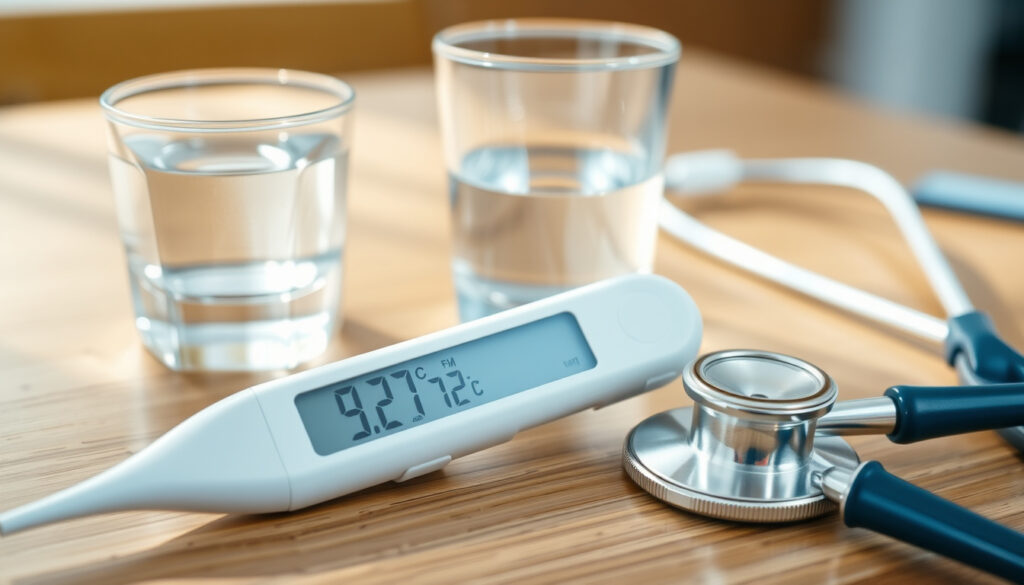
37.2 Celsius to Fahrenheit: Is It a Fever or Normal?
A reading of 37.2°C on a thermometer often leaves people wondering whether to worry or shrug it off — it’s a temperature that sits right on the edge of what’s considered normal for most adults. Understanding the conversion to Fahrenheit and the health context can help you make an informed decision.
37.2 Celsius in Fahrenheit: 98.96°F ·
Body temperature considered normal oral range: 97°F–99°F (36.1°C–37.2°C) ·
Fever threshold for adults (oral): ≥100.4°F (38°C) ·
Fever threshold for children (rectal): ≥100.4°F (38°C) ·
Low-grade fever range: 99°F–100.3°F (37.2°C–37.9°C)
Quick snapshot
- 37.2°C (98.96°F) is within normal oral range for adults (Mayo Clinic (academic medical center))
- Fever threshold for adults oral is ≥100.4°F (38°C) (NHS (UK national health guidance))
- Body temperature normally varies by up to 0.6°C during the day (Cleveland Clinic (nonprofit hospital system))
- Individual baseline temperatures may differ slightly (Mayo Clinic (academic medical center))
- Some guidelines classify 37.5°C–37.9°C as low-grade fever (Centers for Disease Control and Prevention (U.S. federal health agency))
- Fever definition varies by measurement site (oral, rectal, axillary, ear) (Merck Manual Consumer Version (medical reference))
- Body temperature rises up to 0.6°C in the evening due to diurnal rhythm (Cleveland Clinic (nonprofit hospital system))
- After exercise or a hot bath, temp may temporarily reach 37.8°C (100°F) without illness (Harvard School of Public Health (academic institution))
- Low-grade fever after vaccination often lasts 24–48 hours (CDC (U.S. federal health agency))
- Monitor for other symptoms like chills, body aches, or cough (NHS (UK national health guidance))
- Recheck temperature after 30–60 minutes if concerned (Mayo Clinic (academic medical center))
- If temperature rises above 38°C or other red flags appear, contact a healthcare provider (NHS (UK national health guidance))
Six key values define where 37.2°C sits in the big picture of body temperature: one threshold, three ranges, and two measurement contexts.
| Item | Value |
|---|---|
| 37.2°C in Fahrenheit | 98.96°F |
| Normal adult oral range | 36.1°C–37.2°C (97°F–99°F) |
| Fever threshold (adult oral) | ≥38°C (≥100.4°F) |
| Fever threshold (child rectal) | ≥38°C (≥100.4°F) |
| Low-grade fever range | 37.2°C–37.9°C (99°F–100.3°F) |
| 37.2°C rounded | ≈99°F |
The pattern: 37.2°C lands at the top of normal, just one notch below what is officially a fever in adults.
Is 37.2 Celsius considered a fever?
By standard medical definitions, 37.2°C is not a fever for most adults. The oral fever threshold — set by major health agencies — starts at 38°C (100.4°F). For children measured rectally, the same 38°C cutoff applies. But context matters.
What is a normal body temperature?
- Normal oral temperature for adults ranges from 97°F to 99°F (36.1°C to 37.2°C) (Mayo Clinic)
- 78°F–100.4°F oral is the typical variation in healthy people (Cleveland Clinic)
What temperature counts as a fever in adults?
- Oral reading of 100.4°F (38°C) or higher is a fever by CDC and NHS standards (CDC; NHS)
- A low-grade fever is defined as 99°F–100.3°F (37.2°C–37.9°C) oral (Merck Manual)
What temperature counts as a fever in children?
- Rectal temperature ≥100.4°F (38°C) is a fever for infants and children (NHS (UK national health guidance for children))
- Axillary (armpit) readings are about 1°F lower; a fever corresponds to 99.4°F (37.4°C) axillary (Mayo Clinic (academic medical center))
The implication: a single oral reading of 37.2°C is not a fever, but if the measurement site is different or the person is an infant, the interpretation changes.
37.2°C sits exactly on the line between normal and low-grade. For some people — especially children and the elderly — this slight elevation warrants closer monitoring even without other symptoms.
How do you treat a 37.2 fever?
If 37.2°C is accompanied by no other symptoms, treatment is generally not needed. The body’s own regulation handles it. Here’s what to do and when to act.
Self-care for mild temperature (rest, fluids)
- Drink plenty of water or clear liquids to prevent dehydration (NHS)
- Rest and avoid strenuous activity while the body works to regulate temperature (Mayo Clinic)
When to consider medication (acetaminophen, ibuprofen)
- Medication is generally reserved for temperatures above 38°C or when fever causes discomfort (Cleveland Clinic)
- Acetaminophen or ibuprofen can help reduce fever and relieve body aches, but should not be used solely for a borderline reading (NHS)
Warning signs requiring medical attention
- Temperature rising above 103°F (39.4°C) in adults (Mayo Clinic (academic medical center))
- Severe headache, stiff neck, confusion, or difficulty breathing (NHS)
- In infants under 3 months: any fever ≥100.4°F (38°C) requires immediate medical evaluation (NHS children guidance)
What this means: for most adults, 37.2°C alone is not a reason to medicate. The body’s immune response can run its course.
Is 37.2 in the evening normal?
Body temperature follows a natural 24-hour rhythm: it’s lowest in the early morning and peaks in the late afternoon or evening. A 37.2°C reading in the evening is normal for many people.
Body temperature variations throughout the day
- Core temperature can increase by up to 0.6°C (1°F) from morning to evening (Cleveland Clinic)
- This means a morning temperature of 36.6°C (97.9°F) could rise to 37.2°C (98.96°F) by evening without any illness (Merck Manual)
Normal diurnal rhythm
- The circadian rhythm causes temperature to rise about 0.5°C starting around 4:00 PM and peaking around 8:00 PM (National Heart, Lung, and Blood Institute (U.S. federal health agency))
Impact of activity, meals, and ambient temperature
- Exercise, eating, drinking hot beverages, and being in a warm room can temporarily raise oral measurements by 0.2°C–0.5°C (Cleveland Clinic)
- Reportedly, even stress or emotion can cause a small transient increase (Your Health Magazine (health information site))
The pattern: a late-day 37.2°C reading is usually a normal variation, not a sign of infection.
If you take your temperature at 7 PM and get 37.2°C, don’t panic. Compare it with your morning baseline. A difference of 0.5°C within the same day is expected and healthy.
At what temperature should you start to worry?
Knowing when to worry about a fever means understanding the thresholds for different ages and the accompanying symptoms. The numbers are a starting point, not the whole story.
Fever thresholds for adults
- Oral temperature ≥100.4°F (38°C) is the standard fever threshold (CDC)
- Seek medical care if temperature reaches 103°F (39.4°C) or higher, or if fever persists more than 3 days (Mayo Clinic)
Fever thresholds for children (specific ages)
- Infants 0–3 months: rectal temperature ≥100.4°F (38°C) — call doctor immediately (NHS children guidance)
- Children 3–6 months: rectal temperature ≥102°F (38.9°C) — consult pediatrician (Harvard Health Publishing (Harvard Medical School))
- Children older than 6 months: fever >102°F (38.9°C) warrants a call if the child appears uncomfortable or has other symptoms (Mayo Clinic)
Signs of serious illness (rigors, confusion, dehydration)
- Severe shaking chills (rigors) can indicate a bacterial infection (NHS)
- Confusion or difficulty waking up, rapid breathing, chest pain, or signs of dehydration (dry mouth, no tears, decreased urination) (Mayo Clinic)
The trade-off: a single number never tells the full story. A 37.2°C temperature with severe rigors is more concerning than a 38.5°C with mild sniffles.
How to convert 37.2 Celsius to Fahrenheit
Converting 37.2°C to Fahrenheit is a straightforward calculation. Here’s how to do it step by step, along with a quick reference for common temperatures.
Conversion formula: (°C × 9/5) + 32
- Use the standard formula: °F = (°C × 9/5) + 32 (RapidTables (educational reference))
- Plug in 37.2: 37.2 × 9/5 = 66.96
- Add 32: 66.96 + 32 = 98.96°F
- Rounded to the nearest whole degree, that’s 99°F (Symbolab (mathematical reference))
Quick reference: common fever temperatures in Fahrenheit
- 37°C = 98.6°F (traditional normal)
- 37.2°C = 98.96°F (≈99°F)
- 37.5°C = 99.5°F
- 37.8°C = 100°F
- 38°C = 100.4°F (fever threshold)
- 38.5°C = 101.3°F
- 39°C = 102.2°F (moderate fever)
The pattern: many online converters show 37.2°C as 98.96°F, which is barely above the classic 98.6°F average.
Is 37.2 a high fever for a flu?
Influenza typically causes higher fevers. A 37.2°C reading is generally not a high fever in the context of the flu, but it can be present in mild cases or early in the infection.
Typical fever range with influenza
- Flu commonly triggers fevers between 100°F and 102°F (37.8°C–38.9°C) (Harvard Health Publishing (Harvard Medical School))
- Some cases, especially in children, can spike to 103°F–105°F (39.4°C–40.6°C) (Mayo Clinic (academic medical center))
When to worry about high fever with flu
- If fever exceeds 103°F (39.4°C) or doesn’t come down with medication (NHS (UK national health guidance))
- Fever lasting more than 3 days may indicate a secondary bacterial infection (CDC (U.S. federal health agency))
Distinguishing mild from severe illness
- Mild flu often presents with low-grade fever (37.2°C–37.9°C), cough, sore throat, and body aches (Harvard Health)
- Severe illness includes high fever, difficulty breathing, chest pain, confusion, or severe weakness (Mayo Clinic)
The implication: 37.2°C with flu symptoms suggests a mild case, but worsening fever or breathing problems require prompt medical attention.
If you have flu-like symptoms and your temperature suddenly jumps from 37.2°C to 39°C within 24 hours, that escalation — not the starting number — is the red flag.
Confirmed facts
- 37.2°C (98.96°F) is not a fever in adults by standard definitions (CDC; NHS)
- Fever threshold for adults (oral) is ≥100.4°F (38°C) (CDC)
- Fever threshold for children (rectal) is ≥100.4°F (38°C) (NHS children guidance)
- Body temperature normally varies by up to 0.6°C during the day (Cleveland Clinic)
What’s unclear
- Individual baseline body temperature may differ slightly (Mayo Clinic)
- Some guidelines consider 37.5°C–37.9°C as low-grade fever (Merck Manual)
- Fever definition varies between oral, rectal, axillary, and ear measurements (Merck Manual)
- Reportedly, a single 37.2°C reading can be influenced by exercise, warm environments, and food/drink intake (Your Health Magazine)
- The exact fever threshold may vary by age, health conditions, and individual metabolism (Mayo Clinic)
Normal body temperature varies from person to person and throughout the day. A temperature of 37.2°C can be perfectly normal, especially if measured in the evening.
Fever is not defined by a single number. It’s a temperature of 100.4°F (38°C) or higher measured orally. But even that threshold is not absolute — context and symptoms matter.
Mayo Clinic (academic medical center)
If your child has a temperature between 37.5°C and 37.9°C but is playing and eating normally, there is usually no cause for concern. Observe for other signs of illness.
NHS (UK national health guidance for children)
For anyone monitoring their own temperature at home, the practical takeaway is clear: 37.2°C is almost never an emergency, but it is a signal to pay attention to context — the time of day, the measurement method, and other symptoms. If the number rises above 38°C, or if you feel unwell regardless of the number, seeking medical advice is the right move.
For context, a similar temperature reading of 37.4°C also falls below the standard fever threshold but may still prompt monitoring.
Frequently asked questions
Is 37.3 Celsius a fever?
Yes, 37.3°C (99.14°F) falls within the low-grade fever range (37.2°C–37.9°C) for oral measurements. It’s not a fever by strict definition (≥38°C), but it is above the normal range for most people (NHS).
Why does body temperature increase in the evening?
Your body follows a circadian rhythm: core temperature typically drops in the early morning and rises by up to 1°F (0.6°C) as the day progresses, peaking around 6–8 PM (NHLBI).
Can stress cause a low-grade fever?
Stress can trigger a small, temporary rise in body temperature, sometimes called psychogenic fever. It usually resolves once the stressor passes and rarely exceeds 37.5°C (Merck Manual).
Should I stay home with 37.2 temperature?
If you feel well otherwise, 37.2°C alone does not require staying home. However, if you have any other symptoms (cough, sore throat, fatigue), it’s wise to rest and avoid spreading potential infection (CDC).
Is 37.2 a fever for a baby under 3 months?
For infants under 3 months, a rectal temperature of 100.4°F (38°C) or higher is a fever. 37.2°C (98.96°F) is normal. However, if the baby seems ill or has other symptoms, consult a health care provider (NHS children guidance).
Does 37.2 mean I have an infection?
Not necessarily. Many infections cause fevers above 38°C. A reading of 37.2°C could be normal, a mild infection, or even the start of a fever that hasn’t peaked yet. Monitor for other signs (Mayo Clinic).
More related posts
 Sunjay Kapur: Death, Inheritance Feud and Bee Rumor Explained
 The Ministry of Ungentlemanly Warfare: True Story & Where to Watch
 When They See Us: True Story, Cast, Lawsuits Explained
 Apartments for Sale Vancouver – Complete 2025 Guide
 Jon Rahm: Age, Net Worth, LIV Contract & Disability Rumor
 Toronto Raptors vs Sacramento Kings Match Player Stats – Box Score & Key Stats
 Scott Disick: Net Worth, Family, and Life Updates
