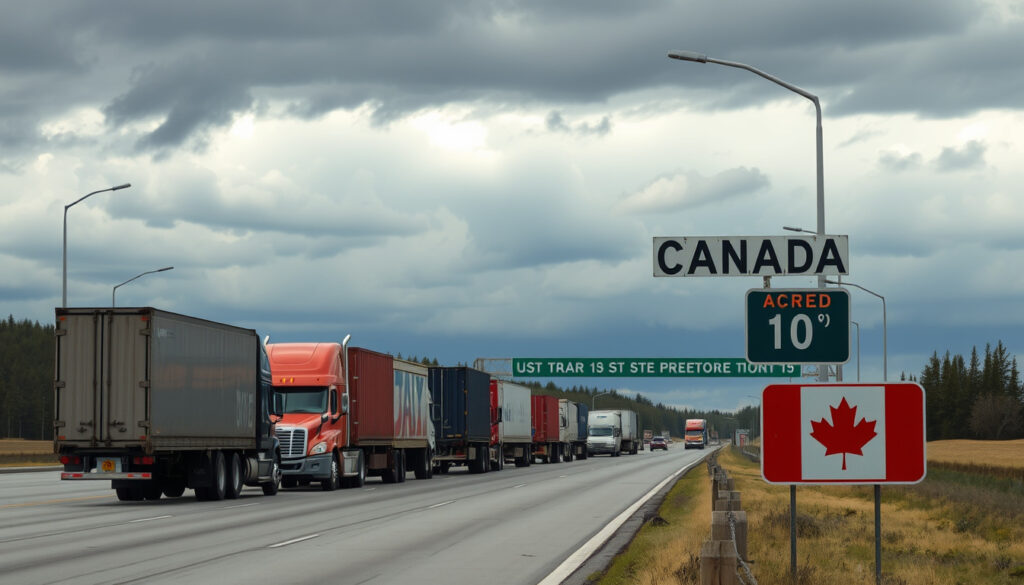
Why Trump Is Putting Tariffs on Canada: Trade War Explained
If you’ve been wondering why President Trump keeps targeting Canada with tariffs, you’re not alone. The answer weaves together border security, fentanyl smuggling, and a massive trade imbalance—with a dose of annexation rhetoric thrown in; on February 1, 2025, the White House announced 25% tariffs on most Canadian goods, kicking off a trade war that has escalated through 2026, affecting your wallet and the fragile relationship between the two neighbors.
Initial tariff rate on Canadian imports: 25% (announced February 1, 2025) ·
Threatened tariff rate if Canada deals with China: 100% (January 2026) ·
Canada’s retaliatory tariff value: 155 billion CAD on U.S. goods ·
Primary stated justification: Fentanyl smuggling, trade deficit, and border security
Quick snapshot
- Trump imposed 25% tariffs on Canada on February 1, 2025 (White House fact sheet)
- Canada retaliated with tariffs on $155 billion CAD of U.S. goods (Government of Canada trade response)
- Whether tariffs will push Canada into a recession
- Long-term impact on US-Canada diplomatic relations
- Whether the 100% tariff threat will be enacted
- Feb 1 2025: 25% tariffs imposed (White House)
- Jul 11 2025: Trump threatens 35% tariff (Reuters)
- Jan 24 2026: 100% tariff threat if Canada deals with China (Reuters)
- Possible 100% tariff on all Canadian goods by early 2026
- Further Canadian retaliatory measures under consideration
- Potential USMCA renegotiation talks
Six snapshot facts that capture the basic shape of the dispute.
| Label | Value |
|---|---|
| Current tariff rate | 25% (with threat to increase to 35% or 100%) |
| Date of first tariff | February 1, 2025 |
| Primary justification | Fentanyl smuggling, trade deficit, border security |
| Canada’s response | Retaliatory tariffs on $155 billion CAD of U.S. goods |
| Economic impact | Canadian GDP growth slowed; U.S. consumer prices rose for affected goods |
| Political context | Trump’s “51st state” rhetoric and annexation talk |
Why is Trump putting tariffs on Canada?
Why did Trump impose tariffs?
The official justification, laid out in a White House fact sheet, cites three pillars: fentanyl smuggling, a trade deficit, and border security. The northern border, the document argues, has become a conduit for illicit drugs and unauthorized migrants. President Trump framed the tariffs as a tool to force Canada to change its border policies.
- Fentanyl seizures at the northern border have increased sharply in recent years.
- Canada runs a trade surplus with the U.S., which Trump targets as unfair (Reuters timeline).
- Trump also raised concerns about Chinese goods transshipped through Canada (Reuters July letter).
The stated reasons—drugs, deficit, border—are real, but the magnitude of the tariffs suggests a broader ambition to reshape North American trade entirely. The White House itself called the measures a “decisive response” to a crisis it painted as existential.
The implication: the official reasons mask a broader ambition to reorder North American trade.
Why did Trump tariff Canada?
Beyond the stated reasons, Trump has a history of using tariffs as bargaining chips. In his first term, he threatened tariffs on Mexican goods to force immigration cooperation. The Canada tariffs follow the same playbook: apply economic pain to extract policy concessions. A Reuters analysis notes that the February 1 tariffs included a 10% rate on Canadian energy—an attempt to pressure Canada on energy exports while keeping gasoline prices in check (Reuters timeline).
Why is Trump putting tariffs on Canada and Mexico?
Trump justified the tariffs against both neighbors simultaneously, arguing that both countries allowed fentanyl and migrants to flow into the U.S. The February 1 executive order applied 25% tariffs to both Canada and Mexico, with a 10% rate on Canadian energy. Mexico, like Canada, faced retaliatory measures and eventually secured a temporary reprieve in April 2025 when USMCA-compliant goods were exempted from the universal tariff (Reuters global tariff announcement).
The pattern: both neighbors were treated as vectors of the same problems, even though Canada accounts for a tiny fraction of U.S. fentanyl deaths. The implication is that trade leverage, not proportionality, drives the policy.
What is Trump trying to achieve?
Four strategic objectives emerge from the administration’s actions and statements.
- Reduce the U.S. trade deficit with Canada. The White House fact sheet directly mentions the trade imbalance as a reason for the tariffs.
- Bring manufacturing jobs back to the United States. Higher import costs theoretically incentivize domestic production.
- Pressure Canada to tighten border security and stop fentanyl flows. Trump has repeatedly demanded that Canada classify drug cartels as terrorist organizations.
- Leverage economic weight to renegotiate trade terms (USMCA). The 2026 review of the USMCA provides an opening for major changes (Reuters timeline).
For Canadian exporters—especially in agriculture and auto parts—the tariff regime is existential. Every percentage point of tariff erodes their price advantage in the U.S. market. The 100% threat would effectively shut down bilateral trade in many sectors.
What this means: the tariff strategy is as much about foreign policy leverage as it is about trade balance.
Trump’s own words reveal an additional layer: in January 2026 he threatened 100% tariffs if Canada makes a trade deal with China. That threat, reported by Reuters, shows the tariffs are also a tool to keep Canada aligned with U.S. foreign policy.
Who pays the US tariffs on Canada?
This is the most misunderstood part of the tariff debate. The tariffs are paid by U.S. importers—American companies that bring Canadian goods into the United States. They pay the duty to U.S. Customs and Border Protection at the port of entry.
- Importers pay upfront. A U.S. retailer importing Canadian lumber pays the 25% tariff when the shipment clears customs (CBC News).
- Costs get passed on. Importers raise prices to cover the tariff. American consumers end up paying more for Canadian goods like lumber, produce, and vehicles.
- Canadian exporters feel the squeeze. Faced with lower demand or price pressure, some Canadian producers cut margins or lose market share.
- Exemptions exist. Goods that comply with USMCA rules of origin can still enter tariff-free—unless the tariff applies to all imports regardless of origin (as with the 25% tariff that started in February 2025).
The trade-off: U.S. consumers pay more, Canadian exporters earn less, and the U.S. government collects the tariff revenue. In 2025, tariff collections from Canada alone were projected in the tens of billions.
Who benefits from a tariff?
Tariffs create winners and losers. The short answer domestic U.S. producers in protected industries benefit because foreign competition becomes more expensive. But the picture is more nuanced.
- U.S. domestic producers in steel, aluminum, and lumber have seen increased orders and higher prices. The 25% tariff on Canadian steel gave American mills a pricing advantage.
- Workers in those industries may see job gains, though the effect is modest when overall demand is flat.
- Consumers face higher prices on everything from Canadian maple syrup to car parts. The Tax Foundation estimated that the 25% tariff on Canada and Mexico could reduce U.S. GDP by 0.5% over two years.
- Retaliatory tariffs hurt U.S. exporters. Canada’s counter-tariffs target American agricultural products, manufactured goods, and vehicles—directly hitting farmers and factory workers in the U.S. (Government of Canada retaliation measures).
The pattern: tariff benefits are concentrated and visible (steel mills restarting), while the costs are diffuse and hidden (higher grocery bills). This asymmetry makes tariffs politically durable even when economically painful.
What is Canada’s relationship with Trump?
Historically, U.S.-Canada relations have been among the closest in the world—deep economic integration, shared defense, and cultural ties. But Trump’s second term has tested that relationship like never before.
Trump has repeatedly criticized Canada for its trade surplus with the U.S. and for spending below NATO’s 2% GDP target on defense. He has also floated the idea of making Canada the 51st state, a comment widely seen as rhetorical pressure rather than a real policy proposal (Reuters).
Why does Trump want Canada to be the 51st state?
Trump’s “51st state” comments began in late 2024 during tariff negotiations. At a press conference, he suggested that Canada would be better off as a U.S. state, eliminating the trade deficit and border issues. Experts view it as a negotiation tactic—creating uncertainty to force concessions. Prime Minister Justin Trudeau has dismissed the idea outright (CBC News political analysis). Experts view it as a negotiation tactic—creating uncertainty to force concessions, and for more on this, you can read about La vida de Kristin Cavallari després del divorci.
The relationship remains adversarial: Trump imposes tariffs, Canada retaliates, and each escalation reduces trust. Government of Canada response page notes that Canadian countermeasures have been carefully calibrated to target politically sensitive U.S. states and products.
Timeline of tariffs and retaliation
Fourteen months of escalating measures, one pattern: each U.S. tariff produces a Canadian response that is slightly larger in scope.
- – Trump imposes 25% tariff on most Canadian goods; 10% on energy.
- – Canada responds with 25% tariffs on $30 billion CAD of U.S. goods (Government of Canada response).
- – U.S. adds 25% tariffs on steel and aluminum from Canada (Reuters steel/aluminum tariffs).
- – Universal 10% tariff announced; Canada and Mexico exempted for USMCA goods (Reuters global tariff announcement).
- – Canada retaliates with tariffs on U.S. vehicles (CBC News auto retaliation).
- – Trump threatens 35% tariff on Canada starting August 1 (Reuters July tariff letter).
- – Trump threatens 100% tariff if Canada negotiates a trade deal with China.
The pattern: each escalation by the U.S. is met with an equivalent or larger Canadian response, creating a cycle that deepens economic separation.
Confirmed facts
- Trump imposed 25% tariffs on Canada in February 2025.
- Trump threatened 100% tariffs if Canada deals with China (Reuters tariff letter).
- Canada imposed retaliatory tariffs on U.S. goods.
What remains unclear
- Whether tariffs will lead to a recession in Canada.
- Long-term impact on US-Canada diplomatic relations.
- Whether the 100% threat will be enacted.
Quotes from key players
“The President is taking bold action to hold our trading partners accountable for the flow of fentanyl and illegal immigration into the United States.”
– White House fact sheet, February 1, 2025 (White House fact sheet)
“Canada will not stand by while our workers and businesses are attacked. We are imposing tariffs on $155 billion of U.S. goods.”
– Prime Minister Justin Trudeau, as reported by Government of Canada response page
“If Canada makes a trade deal with China, they will face 100% tariffs across the board.”
– President Donald Trump, via social media, January 24, 2026 (Reuters)
The tariff dispute is not just about trade—it is about the future of North American economic integration. For Canadian businesses, the uncertainty is paralyzing. For U.S. consumers, the cost shows up in higher prices at the lumber yard and the grocery store. The 100% tariff threat, if executed, would sever decades of supply chain ties overnight. For the Trump administration, the gamble is that economic pain will force Canada to bend on border policy, defense spending, and trade terms. For Ottawa, the choice is stark: accommodate, retaliate, or find new markets—fast.
Frequently asked questions
How do tariffs on Canada affect U.S. consumers?
U.S. importers pay the tariff and typically pass the cost to consumers through higher prices. Goods affected include lumber, produce, automobiles, and energy.
What goods from Canada are hit hardest by the tariffs?
Steel, aluminum, lumber, dairy, and automobiles face the highest rates. Energy products were initially taxed at 10% but later included under the 25% regime.
Will the tariffs be permanent?
Trump has tied tariff removal to Canadian action on fentanyl and border security. They could be lifted if Canada meets his demands, but there is no fixed timeline.
How has Canada retaliated against U.S. tariffs?
Canada placed 25% tariffs on $30 billion CAD of U.S. goods initially, then expanded to $155 billion CAD, targeting agriculture, manufacturing, and vehicles.
Is the 51st state comment related to the tariffs?
Trump’s rhetoric is widely seen as a negotiating tactic to increase pressure on Canada during tariff talks. It is not official policy.
Which U.S. industries benefit from these tariffs?
Domestic steel and aluminum producers, lumber companies, and some manufacturers have gained pricing power. However, downstream industries that use these inputs face higher costs.
What is the role of fentanyl in Trump’s tariff policy?
Fentanyl smuggling at the northern border is a stated justification. The White House claims that tariffs pressure Canada to crack down on precursor chemicals and cartels.
More related posts
 Canadian Dollar Price in India: CAD to INR Rates & Tips
 West Ham vs Brighton: TV Channel, Prediction & Head-to-Head Stats
 Alexa Bliss: Biography, Husband, and WWE Status
 Early Retirement Incentive Canada 2026: Eligibility & Benefits
 Bahia Principe Grand Coba: All-Inclusive Resort Guide
 Grand Park Royal Cozumel: All-Inclusive Resort Review
 Quebec Government Authentication Service Login Guide
 Abbotsford to Calgary Flights: Cheap Deals from $127
