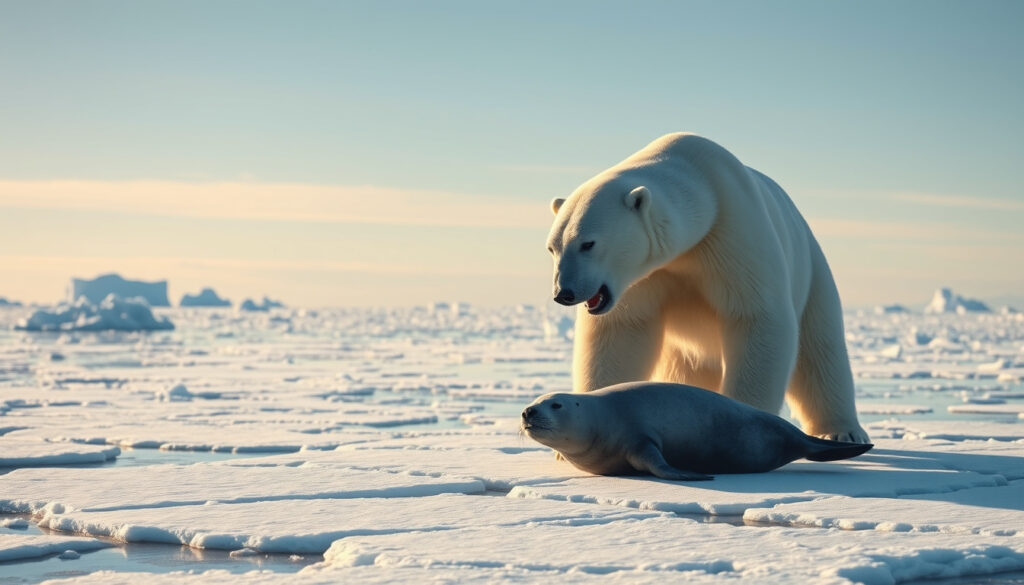
What Do Polar Bears Eat – Seals, Hunting Facts & Myths
Polar bears have one of the most specialized diets in the animal kingdom. These Arctic predators rely almost entirely on ringed and bearded seals, consuming extraordinary amounts of fat to survive in one of Earth’s harshest environments. Understanding what polar bears eat reveals not only their biological adaptations but also the fragile balance of Arctic marine ecosystems facing rapid environmental change.
Research published through the National Center for Biotechnology Information confirms that seals comprise the overwhelming majority of polar bear diets across their range. Fatty acid analysis from studies conducted between 2013 and 2016 in the southern Beaufort Sea demonstrates that ringed seals alone account for approximately 46% of dietary intake. This reliance on seal blubber provides the concentrated energy these massive animals require to maintain body heat, reproduce, and survive months of fasting when sea ice disappears.
What Do Polar Bears Primarily Eat?
The polar bear diet centers on ice-associated seal species, with three main prey types dominating across different regions and seasons. Ringed seals serve as the primary food source throughout most of the Arctic, while bearded seals provide important secondary prey. Harp seals become seasonally significant in areas like Western Hudson Bay, particularly during spring and summer migrations when large numbers pass through available hunting grounds.
- 46% of southern Beaufort Sea diet consists of ringed seals, based on fatty acid analysis from 2013-2016
- Bearded seals account for roughly 20% of overall dietary intake in most regions
- Seal blubber provides concentrated fat essential for maintaining body temperature in Arctic conditions
- Adult and subadult females show stronger preference for ringed seals than males
- Diet composition shifts between harp and ringed seals over time, as documented from 1984-2001 data
- Onshore food sources have increased since the early 2000s as sea ice decline accelerates
| Fact | Details | Source Type |
|---|---|---|
| Main Food Source | Ringed seals, bearded seals, harp seals | Peer-reviewed studies |
| Ringed Seal Percentage | Approximately 46% in southern Beaufort Sea | NCBI research (2013-2016) |
| Bearded Seal Percentage | Around 20% of diet | Ecological Monographs |
| Secondary Prey | Seabirds (17%), whale remains (15%), beluga (2%) | Field studies |
| Diet Classification | Hypercarnivore, not omnivore | Wildlife organizations |
| Regional Variation | Harp seal emphasis in Western Hudson Bay | Long-term monitoring |
Do Polar Bears Eat Penguins and Other Misconceptions?
A persistent misconception suggests polar bears prey on penguins. This confusion arises from the familiar imagery of bears and penguins together in cartoons and media, yet these species never encounter each other in nature. Polar bears inhabit the Arctic regions of the Northern Hemisphere, while penguins live exclusively in the Southern Hemisphere, primarily in Antarctica and surrounding waters. Polar Bears International confirms that penguins form no part of polar bear diets, and this error likely stems from early translation mistakes in educational materials.
Are Polar Bears True Carnivores?
Polar bears are classified as carnivores, specifically hypercarnivores, evolved over millennia for efficient seal predation. Unlike brown bears, which readily consume berries, roots, fish, and diverse vegetation, polar bears possess physiological adaptations optimized for processing animal fat and protein. Their digestive systems, jaw structure, and hunting behaviors all reflect strict carnivorous specialization rather than the omnivorous flexibility of their terrestrial relatives.
Can Polar Bears Survive on Vegetation?
When ice seals become scarce, polar bears occasionally consume vegetation, berries, bird eggs, and carrion. However, these foods cannot sustain them long-term. According to the World Wildlife Fund, polar bears cannot obtain sufficient calories from land-based foods to meet their energy requirements. A single ringed seal provides thousands of calories in concentrated blubber, while equivalent caloric intake from berries or vegetation would require impractical volumes of plant material.
While polar bears demonstrate opportunistic feeding behavior, eating whatever becomes available, this flexibility does not indicate dietary adequacy. Land-based foods supplement the seal-dependent diet during ice-free periods but cannot replace the nutritional value of marine prey.
How Much Food Do Polar Bears Consume?
Polar bear feeding patterns reflect the feast-or-famine reality of Arctic life. After successfully hunting a seal, a polar bear can consume up to 45 kilograms (100 pounds) of blubber in a single sitting. They prioritize the fat-rich skin and blubber, consuming these high-energy portions first before eating the muscle meat. This selective feeding strategy maximizes caloric intake while leaving leaner tissue for scavengers like Arctic foxes and seabirds.
Hunting Techniques and Strategies
Polar bears employ two primary hunting methods adapted to seal behavior and sea ice conditions. The most common technique involves waiting motionless at seal breathing holes, technically called aglus, sometimes for hours or even days until a seal surfaces to breathe. Bears detect seals through their keen sense of smell, sensing the animals through ice up to a meter thick. When the seal appears, the bear delivers a powerful strike with its paw, stunning or killing the prey before dragging it onto the ice.
The second method involves stalking ringed seals resting on the ice surface. The bear approaches slowly, freezing in place if the seal raises its head, then continues crawling until within striking distance of approximately six meters. The final pounce is explosive, with the bear launching itself onto the seal before it can escape into the water.
Ringed seals have evolved to minimize time at breathing holes, surfacing only every 5-15 minutes. This adaptation reduces hunting success rates, explaining why polar bears invest so much time in waiting and why successful kills provide such substantial meals.
Extended Fasting Periods
Polar bears survive months without food during summer when sea ice melts and hunting platforms disappear. Males, non-pregnant females, and subadults may fast for 4-5 months on land, living entirely off accumulated fat reserves. Pregnant females face the longest fasts, remaining in dens for up to 8 months while giving birth and nursing cubs without eating. Research from NCBI documents how interannual diet variability correlates directly with sea ice conditions, with bears consuming less during years with earlier ice breakup.
Polar Bear Diet Variations by Season and Age
Diet composition shifts significantly across seasons, regions, and between individual bears. These variations reflect prey availability, hunting opportunity, and the physiological needs of different age and sex classes. Understanding these patterns helps researchers monitor ecosystem health and predict how polar bear populations will respond to ongoing environmental changes.
Seasonal Diet Shifts
Spring marks the peak hunting season when ringed seal pups are born on stable ice. Polar bears concentrate their feeding during this period, building critical fat reserves for the ice-free summer ahead. Summer brings dramatically reduced feeding opportunities as ice retreats from coastal areas. Bears remaining on land consume whatever they can find—berries, eggs, bird carcasses, and occasionally beached whale remains—but these foods provide minimal caloric value compared to seal blubber.
Fall presents another critical feeding window as sea ice begins reforming. Bears resume active hunting as new ice provides access to seal breathing holes and haul-out areas. WWF Canada notes that this seasonal cycle of feast and famine has shaped polar bear physiology, with adaptations allowing them to build enormous fat reserves rapidly during successful hunting periods.
Western Hudson Bay populations rely more heavily on harp seals during spring and summer migrations, while southern Beaufort Sea bears focus primarily on ringed and bearded seals. These regional differences reflect local prey abundance rather than preferred diet, as seals remain the preferred prey everywhere.
Diet Changes with Age and Climate
Dietary diversity increases with age. Young bears initially learn to hunt seals under their mothers’ guidance, with cubs practicing on smaller prey before mastering adult hunting techniques. Adult bears demonstrate the broadest diet, with larger, older individuals capable of taking bigger prey including beluga whales. Research from Ecological Monographs documents how age-related differences in diet reflect both learned hunting skills and physical capabilities.
Climate change increasingly alters these established dietary patterns. As sea ice declines, polar bears spend more time on land, forcing greater reliance on onshore food sources. Studies from the University of British Columbia document how this dietary shift may have cascading effects through Arctic food webs, with seals themselves changing behavior patterns to access diverse prey despite increased predation risk from bears moving into previously ice-covered areas. Descobreix els diferents tipus de corones dentals i els seus costos en tipus de corones dentals.
Young polar bears learn hunting skills through extended maternal care lasting 2-3 years. Cubs initially consume their mother’s milk, then learn to scavenge from her kills before practicing increasingly sophisticated hunting techniques on ice. This learning period is critical, as successful seal hunting requires skills that must be taught rather than purely instinctive.
Polar Bear Feeding Timeline
The annual feeding cycle of polar bears follows predictable patterns tied to Arctic seasons and sea ice dynamics. Understanding this timeline reveals why polar bears face increasing challenges as climate change alters the timing and duration of ice conditions.
- Spring (April-May): Peak seal hunting as ringed seal pups are born on stable ice. Bears build critical fat reserves for summer fasting.
- Early Summer (June-July): Ice breaks up, hunting opportunities decline sharply. Bears begin fasting on land as ice retreats.
- Late Summer (August-September): Extended fasting period with minimal food intake. Bears rely entirely on stored fat reserves.
- Fall (October-November): Sea ice reformation provides renewed hunting access. Bears resume active feeding as conditions allow.
- Winter (December-March): High blubber intake period. Pregnant females enter dens; others continue hunting on stable ice.
What We Know and What Remains Uncertain
| Established Information | Uncertain or Evolving Understanding |
|---|---|
| Seals comprise 90%+ of polar bear diet in most regions | Precise extent of dietary shifts due to climate change |
| Ringed seals are primary prey across Arctic | Long-term population impacts of reduced seal availability |
| Polar bears can consume 45 kg in single feeding | Specific energetic consequences of dietary changes |
| Extended summer fasting is natural behavior | How fasting duration will change with ice loss |
| Regional dietary variations exist | Future prey switching possibilities and success rates |
| Onshore foods cannot sustain polar bears long-term | Potential for physiological adaptation to new food sources |
The Broader Ecological Context
Polar bears occupy a critical position as apex predators in Arctic marine ecosystems. Their seal hunting shapes seal population dynamics, which in turn influences the fish and invertebrates that seals consume. This top-down control means that changes in polar bear populations or hunting success cascade through the entire food web. Polar Bears International notes that polar bears essentially structure Arctic marine food webs through their predation patterns.
The relationship between polar bears and their prey extends beyond simple predator-prey dynamics. Seals have evolved behaviors to reduce predation risk, including minimizing time at breathing holes and selecting haul-out locations with escape routes. Recent research from the University of British Columbia documents how seals balance the nutritional benefits of accessing diverse prey against the increased risk of encountering polar bears in newly accessible areas. These behavioral adaptations suggest an ongoing evolutionary arms race that climate change may disrupt in unpredictable ways.
Expert Perspectives and Research Sources
“Polar bears are the most carnivorous of all bear species, having evolved over thousands of generations to exploit a narrow dietary niche centered on ice seals. Their survival depends entirely on the continued availability of these prey species.”
— Polar Bears International, Polar Bear Facts: Diet and Prey
“While polar bears demonstrate remarkable dietary flexibility when traditional prey becomes unavailable, this behavioral adaptability should not be mistaken for nutritional adequacy. Land-based foods cannot substitute for the concentrated energy of marine mammal blubber.”
— World Wildlife Fund, Polar Bear Species Profile
Key Takeaways
Polar bears are obligate seal hunters whose survival depends on access to ice-associated prey. Ringed seals form the dietary foundation across most of the Arctic, supplemented by bearded seals, harp seals, and occasionally larger marine mammals. A single successful hunt can yield 45 kilograms of nutrient-rich blubber, providing energy reserves for extended fasting periods that are a natural part of the polar bear annual cycle. Climate change increasingly disrupts the predictable feeding patterns that polar bears have evolved to exploit, making understanding their dietary needs essential for conservation planning. Research documented by UBC News demonstrates how both polar bears and their prey are adapting to changing conditions, though the ultimate consequences for Arctic ecosystems remain under active scientific investigation.
Frequently Asked Questions
What percentage of a polar bear’s diet consists of seals?
Seals, primarily ringed seals, comprise approximately 90% or more of polar bear diets in most regions. Ringed seals alone account for about 46% in areas like the southern Beaufort Sea.
How long can polar bears survive without eating?
Polar bears can fast for 4-5 months during summer ice-free periods. Pregnant females may fast for up to 8 months while denning and nursing cubs.
Do polar bears ever eat penguins?
No. Polar bears and penguins never encounter each other in nature. Penguins live only in the Southern Hemisphere, while polar bears inhabit the Arctic.
Can polar bears eat enough vegetation to survive?
No. While polar bears occasionally consume berries, eggs, and vegetation, these foods cannot provide sufficient calories. A single ringed seal contains thousands of calories that would require impractical quantities of plant food to match.
Do polar bears eat fish?
Fish occasionally appear in polar bear diets but represent a minor component. When seals are unavailable, polar bears may consume fish, birds, and small mammals, but these foods cannot sustain them long-term.
What do baby polar bears eat?
Cubs nurse on mother’s milk for about two years while learning to hunt. They begin eating from their mother’s kills and practicing hunting techniques before becoming independent.
More related posts
 Kyle Connor Injury, Stats, and Key Facts 2025-26
 George of the Jungle – Iconic 1967 Cartoon Parody
 Alien: Earth Release Date, Schedule & Season 2 News
 The Three Musketeers: D’Artagnan (2023) – Cast, Plot, Part 2 Info
 Steve Jobs: Cause of Death, Will, Personal Habits & Legacy
 TD Bank Share Price – Live TSX NYSE Data Dividends
 Sean Avery: NHL Troublemaker Turned Author & Actor
 Alessandra Ambrosio: Age, Height, Net Worth, Children, Pregnancy
