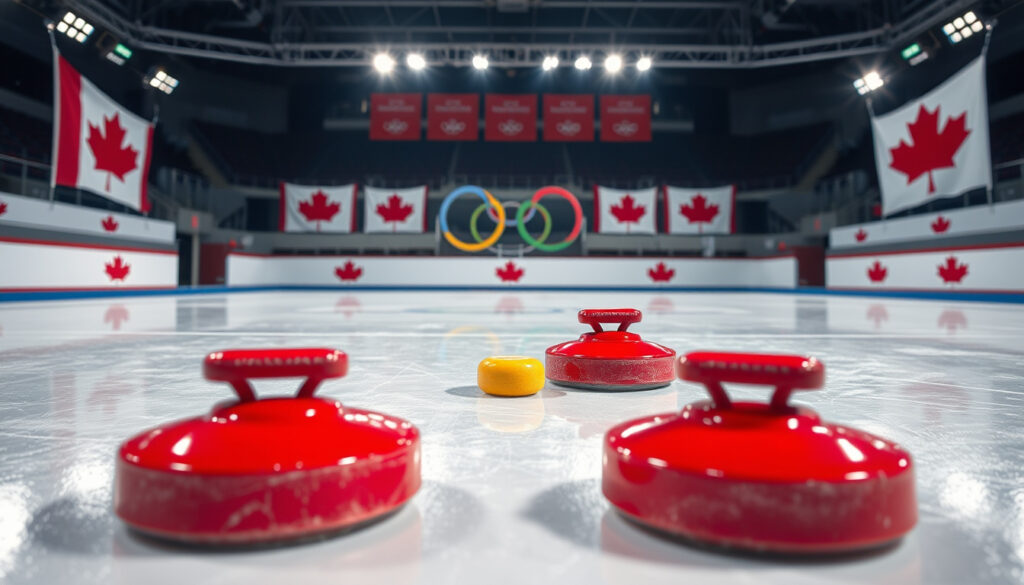
Canada Curling Cheating Olympics – Homan Double-Touch Explained
At the 2026 Winter Olympics in Milano Cortina, two separate controversies involving Canada’s curling teams sparked widespread debate about rules enforcement and fair play. The incidents, which occurred during round-robin competition rather than the semifinals as initially reported in many queries, centered on alleged violations of the World Curling Federation’s handling and release regulations.
Rachel Homan, skip of Canada’s women’s team, was penalized during a match against Switzerland after officials determined she had touched a stone after releasing the handle—a ruling known as a double-touching violation. A separate dispute emerged in the men’s competition when Sweden accused Canada’s Brad Jacobs rink of similar infractions during a round-robin encounter.
The controversies prompted the World Curling Federation to issue clarifying guidance to all competing teams and intensified discussions about rule enforcement at elite levels of the sport.
Did Canada Cheat in Curling at the Olympics?
The question of whether Canadian curlers violated rules at the Olympics requires examining specific incidents that occurred during the 2026 Milano Cortina Games. Both the women’s and men’s Canadian teams became involved in disputed rulings that led to accusations and counter-accusations with opposing nations.
Rachel Homan penalized for double-touching against Switzerland
Brad Jacobs team accused by Sweden of double-touching
World Curling Federation officials handled all calls
No further sanctions after WCF review
Key Facts About the Incidents
- Homan’s stone was removed from play after the official’s ruling against Switzerland
- Canada’s women’s team lost the match 8-7 despite the controversy
- Sweden’s accusation against the men’s team resulted in no penalty after review
- Canada’s men’s team won their match against Sweden 8-6
- The World Curling Federation found no violations after reviewing the men’s match
- WCF issued rule clarification emails to all teams following the controversies
| Detail | Women’s Match | Men’s Match |
|---|---|---|
| Opponent | Switzerland | Sweden |
| Canadian Skip | Rachel Homan | Brad Jacobs |
| Nature of Accusation | Double-touching violation | Double-touching alleged |
| Penalty Applied | Stone removed from play | None |
| Final Score | Switzerland 8, Canada 7 | Canada 8, Sweden 6 |
| WCF Finding | Violation upheld | No violation found |
What Happened During the Contested Matches?
The women’s match between Canada and Switzerland took place during round-robin competition at Milano Cortina. Early in the first end, Rachel Homan delivered a stone and the hog line official determined that she had contacted the granite portion of the rock after releasing the handle—constituting a double-touching violation under World Curling Federation rules.
Broadcast microphones captured Homan’s immediate reaction as officials made the call. “Like, absolutely not. Zero percent chance I double touched the rock. I’ve never done it in my life,” she stated while the ruling stood. The disputed stone was removed from play, and Switzerland ultimately secured an 8-7 victory.
Men’s Canada vs. Sweden Controversy
A separate dispute emerged during the men’s round-robin match between Canada and Sweden. The Swedish team, led by Niklas Edin, accused Canada’s Brad Jacobs rink of double-touching stones after they had crossed the hog line. Social media footage that did not originate from Olympic Broadcasting Services appeared to show contact with stones in question.
Canadian curler Marc Kennedy confronted Sweden’s Oskar Eriksson during the match, with heated exchanges captured on broadcast audio. Kennedy’s comments included profanity directed at Eriksson, and he later alleged that Sweden had engaged in premeditated filming of the hog line area using their media crew—a claim Sweden denied.
Niklas Edin, skip of Sweden’s men’s team, defended the filming as standard practice for public broadcasters seeking to explain the sport to viewers. The World Curling Federation reviewed the matter and found no violations on Canada’s part.
Canada’s team executive Nolan Thiessen raised questions about whether Sweden’s video capture complied with Olympic Broadcasting Services regulations. Sweden attributed the filming placement to their public broadcaster’s operational decisions. You can read more about the 2026 Milano Cortina Games on the official Olympic website.
Understanding Double-Touching Rules in Curling
The World Curling Federation establishes specific regulations governing how athletes interact with stones during delivery. These rules exist to ensure fair competition and standardized enforcement across all levels of the sport.
What Constitutes a Double-Touch Violation
Under WCF competition rules, a curler must release the stone using only the handle before it crosses the hog line. Contact with the granite body of the stone after release—whether intentional or accidental—constitutes a double-touching violation. The rule applies regardless of whether such contact would provide any competitive advantage.
When a violation occurs, the affected stone is immediately removed from play. Unlike some sporting rulings, there is no provision for video review of hog line and double-touching calls. The official stationed at the hog line makes the determination, and that decision stands.
World Curling Federation officials monitor deliveries from a position at the hog line. Because visual confirmation must occur in real time, WCF rules do not permit replay footage to overturn these calls. The federation considers the official’s positioning and angle essential to accurate adjudication. For detailed competition regulations, visit the official WCF rulebook.
The Importance of Proper Release Technique
Elite curlers spend considerable time perfecting their release mechanics to avoid violations. A clean release involves the slider hand releasing the handle smoothly as the stone passes the hog line, with no subsequent contact from either throwing hand or the broom.
The controversy at Milano Cortina prompted the WCF to send clarifying communications to all competing teams, emphasizing the precise requirements for proper release under federation rules.
Background on the Canadian Curling Teams
Rachel Homan has established herself among the world’s elite skips through multiple national and international titles. Her reputation for technical precision made the double-touching ruling particularly notable, as the violation appeared inconsistent with her documented consistency in delivery mechanics throughout her career.
The men’s team skipped by Brad Jacobs featured experienced competitors including Marc Kennedy and Ben Hebert, both of whom had previously represented Canada at Olympic Games. Kennedy’s vocal protest during the Sweden match reflected the intensity of competition at the Olympic level, where a single ruling can determine advancement outcomes.
Olympic Curling Competition Context
Olympic curling operates under a round-robin format followed by playoff rounds. Each loss during round-robin competition can significantly impact a team’s position in the standings, making contested calls particularly consequential for medal hopes.
The pressure of Olympic competition, combined with the subjective nature of certain rule interpretations, creates conditions where disputes between teams and officials can emerge. Previous Olympic curling events have seen similar controversies, though none precisely matching the specific circumstances of the 2026 incidents. More details on Canada’s Olympic curling schedule are available on our site.
Multiple queries have referenced a Canada-Sweden women’s semifinal hog line controversy at the 2018 PyeongChang Olympics. No such incident occurred during those Games. Canada’s Jennifer Jones team competed in the women’s event at PyeongChang 2018, while Homan did not compete at those particular Olympics. All documented incidents involving Homan and the men’s Canada-Sweden dispute occurred during the 2026 Milano Cortina Games.
Timeline of Events
The controversies unfolded in close succession during round-robin competition, with the men’s dispute occurring first and prompting increased scrutiny of the women’s match that followed.
- Men’s round-robin match: Canada defeats Sweden 8-6 amid double-touching allegations from the Swedish team
- Social media emerges: Video footage of the men’s match incident circulates on platforms outside Olympic Broadcasting Services
- WCF communication: Federation emails all teams clarifying proper release rules following men’s controversy
- Women’s round-robin match: Switzerland defeats Canada 8-7 after Homan assessed double-touching penalty
- Homan’s response: Broadcast microphones capture the Canadian skip’s denial of the violation
- WCF review: Federation reviews men’s match footage and finds no violations on Canada’s part
- Guidance issued: No additional sanctions against Canadian teams; rule clarification stands
Switzerland’s Pablo Lachat-Couchepin also publicly alleged double-touching by the Canadian women’s team during separate exchanges, adding to the scrutiny surrounding Canada’s handling practices throughout the competition.
What the Evidence Shows Versus What Remains Unclear
Distinguishing between established facts and areas of ambiguity helps contextualize the controversies that emerged during Olympic competition.
| Confirmed Information | Areas of Uncertainty |
|---|---|
| Official ruled Homan committed double-touching; stone removed from play | Whether the contact provided competitive advantage |
| Switzerland defeated Canada 8-7 | How much the penalty influenced the final outcome |
| WCF reviewed men’s match and found no violations | Whether Sweden’s filming constituted premeditated evidence gathering |
| WCF issued rule clarification to all teams | Whether additional rule modifications will result from the incidents |
| No official replay review exists under WCF rules | Long-term implications for officiating protocols |
The Broader Context of Olympic Curling Disputes
Curling has a long history of passionate competition and occasional controversy, particularly around rule interpretation at elite levels. The sport’s combination of physical precision and strategic complexity creates conditions where subjective judgments can spark disagreement between competitors.
The visibility of Olympic competition amplifies disputes that might receive less attention at other levels. Broadcast technology, social media sharing, and the presence of team microphones all contribute to wider awareness of competitive exchanges that previously would have occurred away from public view.
The World Curling Federation’s decision to issue clarifying guidance following the 2026 incidents reflects the federation’s ongoing effort to ensure consistent rule application across all competitions while maintaining the traditions that define the sport. Visit the official World Curling Federation website for comprehensive information about the organization.
Official Statements and Reactions
“Like, absolutely not. Zero percent chance I double touched the rock. I’ve never done it in my life.”
— Rachel Homan, captured on broadcast microphones during the ruling
The Canadian curling organization, through CEO Nolan Thiessen, questioned whether Sweden’s video capture complied with Olympic Broadcasting Services operational guidelines. This stance reflected broader concerns about evidence collection methods and the role of unofficial footage in competitive disputes.
Swedish officials maintained that their public broadcaster’s filming operations complied with standard practices. The federation’s ultimate finding of no violation on Canada’s part resolved the immediate dispute without imposing penalties.
Summary of the Curling Controversies
The curling controversies at the 2026 Milano Cortina Olympics involved two distinct incidents: a confirmed double-touching violation assessed against Rachel Homan’s women’s team during a match against Switzerland, and disputed allegations against Canada’s men’s team during their match against Sweden that resulted in no ruling against Canada.
Both incidents highlighted the precision required in elite curling competition and the potential for subjective judgments to generate competitive tension. The World Curling Federation’s review found no additional violations requiring sanctions beyond the initial ruling against Homan.
For those interested in understanding the technical aspects of rule enforcement in winter sports, the incidents demonstrate how federations balance player safety, competitive fairness, and the practical limitations of real-time officiating. More coverage of Canada’s performance at the 2026 Winter Olympics is available on our platform.
Frequently Asked Questions
What is a double-touching violation in curling?
A double-touch occurs when a curler contacts the granite body of a stone after releasing the handle. The stone must be released using only the handle before crossing the hog line, and any subsequent contact with the granite constitutes a violation under World Curling Federation rules.
Can double-touching calls be appealed using video replay?
No. World Curling Federation rules do not permit video review of hog line and double-touching calls. The official’s determination at the hog line stands as the final ruling, reflecting the federation’s position that real-time observation from that position provides the most accurate assessment.
What happened to Rachel Homan’s team after the violation?
The stone involved in the double-touching violation was removed from play. Switzerland won the match 8-7. The World Curling Federation did not impose additional sanctions beyond the initial ruling, though the incident prompted increased scrutiny of subsequent deliveries by Canadian athletes.
Did the 2018 PyeongChang Olympics have a similar curling controversy?
No. The Canada-Sweden women’s semifinal hog line controversy did not occur at the 2018 PyeongChang Olympics. At those Games, Canada’s women’s team was skipped by Jennifer Jones. All documented incidents involving Rachel Homan and the men’s Canada-Sweden dispute occurred during the 2026 Milano Cortina Olympics.
How did the World Curling Federation respond to the incidents?
Following the men’s Canada-Sweden controversy, the WCF issued an email to all competing teams clarifying the requirements for proper release under federation rules. After reviewing footage of the men’s match, the federation found no violations on Canada’s part. No additional sanctions were imposed.
More related posts
 Whoop-Up Days 2025: Dates, Parade, Fireworks & History
 Tiger Woods Car Accident – 2021 Cause Injuries Recovery
 2025 Liberal Leadership Race Polls: Latest Results & Analysis
 Maria Sharapova 2025: Children, Fiancé, Net Worth
 Gold Price in India – Live 24K and 22K Rates Today
 Andrew Cuomo: From Governor to Mayoral Comeback Bid
 Alexa Bliss: Biography, Husband, and WWE Status
 перевод с английского на русский: Best Free Translators Compared
